
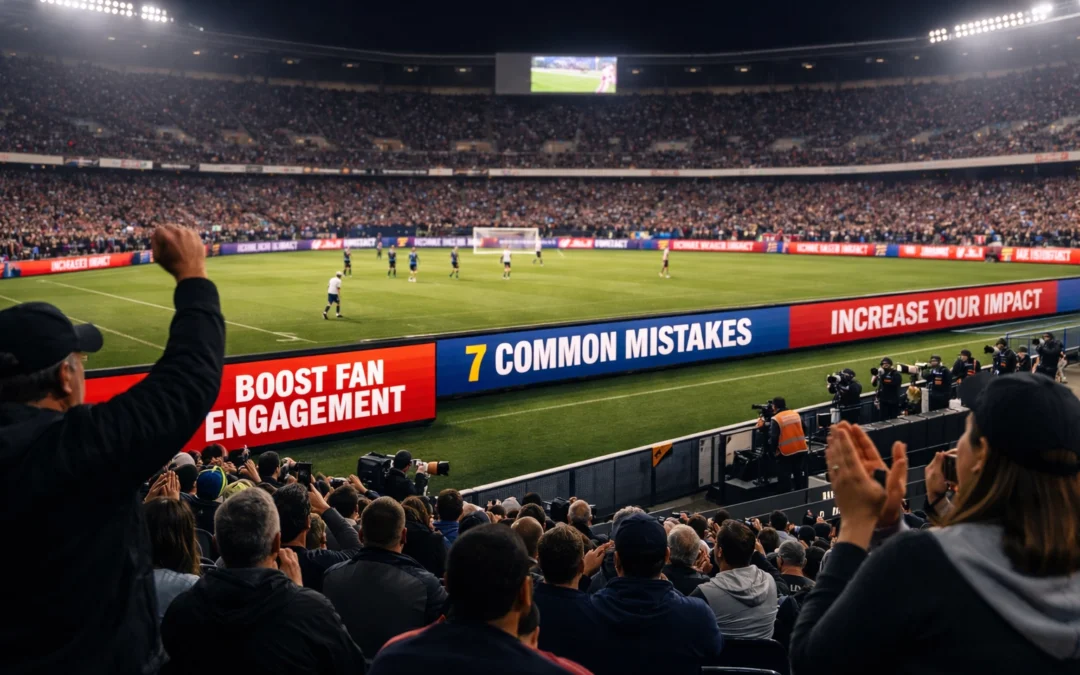
Fan engagement is the cornerstone of successful sports marketing. However, many brands struggle to convert the raw energy of a live game into meaningful brand equity. Creative directors and CMOs often find that traditional methods fall short in an era where attention is the most valuable commodity.
The stadium environment offers a unique psychological state for the consumer. Fans are highly alert, emotionally invested, and part of a collective experience. Despite this, marketing campaigns frequently fail to capitalize on these conditions. Stadium perimeter advertising, particularly through modern Digital Out-of-Home (DOOH) technology, provides a strategic solution to these common pitfalls.
Here are seven mistakes currently hindering fan engagement strategies and the specific ways stadium perimeter ads resolve them.
1. Relying on Static Content in a Dynamic Environment
One of the most frequent errors in sports marketing is the use of static signage. In a fast paced environment like a soccer match or a basketball game, a non-moving board quickly becomes part of the background. Human eyes are biologically programmed to detect motion, making static displays easy to ignore once the initial novelty wears off.
Stadium perimeter LED displays fix this by introducing movement and vibrant color shifts. These displays are designed to capture the eye without distracting from the game itself. By utilizing dynamic content, brands can ensure their message remains prominent throughout the entire duration of the event. This constant visual presence is essential for maintaining brand salience in a high-stimulation environment.
2. Ignoring Real-Time Context and Game Momentum
Fans do not experience a game as a linear series of events. They experience it as a sequence of high-intensity moments followed by lulls. A common mistake is delivering a generic brand message that ignores the current state of the game. For example, showing a lighthearted ad immediately after a controversial call or a significant injury can create a disconnect with the audience.
Digital perimeter ads allow for real-time synchronization with the live event. If a goal is scored or a home run is hit, the perimeter boards can instantly pivot to celebratory content. This creates a psychological link between the brand and the fan's positive emotional state. By aligning messaging with game-time triggers, brands move from being a "distraction" to being part of the celebration.

3. Failing to Bridge the Gap Between In-Stadium and Broadcast Audiences
Many marketers treat the stadium audience and the broadcast audience as two separate entities. This is a strategic oversight. While there may be 50,000 people in the stands, there are often millions watching at home. A static banner in the corner of the field might be visible to a small section of the stadium but is frequently lost in the broadcast camera angles.
Modern stadium perimeter advertising is engineered for "TV visibility." The placement, brightness, and refresh rates of these LED screens are optimized to ensure they appear clearly on high-definition broadcasts. This means a single placement captures the attention of the local crowd while simultaneously reaching a global audience. This dual-reach capability significantly lowers the cost per impression and ensures the brand message is part of the "official" visual narrative of the game.
For a deeper look at how digital placements drive massive shifts in brand perception, consider how AB InBev’s Mike’s Hard Iced Tea saw a 119 percent lift in positive brand image through strategic programmatic DOOH.
4. Overlooking the Power of Hyper-Local Targeting
A "one size fits all" approach rarely works in sports. A brand might have a completely different objective in a New York stadium than it does in a Los Angeles arena. Mistakenly running the same creative across all regions ignores local culture, team rivalries, and regional consumer behavior.
Stadium perimeter ads powered by programmatic technology allow for hyper-local targeting. Creative directors can tailor messages to specific cities or even specific matchups. If a brand wants to target sports bettors in a state where gambling was recently legalized, they can deploy specific creative to those stadiums exclusively. This level of precision ensures that the marketing spend is concentrated where it will have the highest impact.
Strategic geographical targeting has been shown to boost engagement significantly. In fact, geographically targeted DOOH strategies have boosted fan engagement by 90 percent.
5. Managing High Costs with Low Flexibility
Traditional stadium sponsorships often require multi-million dollar, multi-year commitments. For many brands, this creates a barrier to entry or ties up the budget in a way that prevents agility. The mistake here is assuming that the only way to get onto the field is through these massive, rigid contracts.
The rise of digital perimeter advertising has democratized access to the stadium. Through programmatic buying, brands can purchase space for specific games or even specific hours of an event. This allows for a "flighted" approach to sports marketing. Instead of a permanent sign that sits unchanged for three years, a brand can dominate the perimeter for a high-profile playoff game and then rotate the budget elsewhere.
Smart brands are increasingly choosing this flexible model. It is now possible to achieve high-impact stadium presence for significantly less than a traditional sponsorship. Some data suggests that smart brands scale with perimeter DOOH for 80 percent less than the cost of a full-season sponsorship.

6. Neglecting Data and Measurability
For decades, sports marketing was measured by "gut feeling" and approximate attendance figures. A major mistake modern marketers make is applying this outdated logic to current campaigns. If you cannot measure the lift in purchase intent or the specific audience reached, the campaign is operating in a vacuum.
Stadium perimeter DOOH integrates with modern analytics platforms. By using anonymized mobile location data and broadcast viewership metrics, marketers can track who was exposed to the ad and what they did next. Did they visit the brand’s website? Did they search for the product on their phone during halftime? This data-driven approach allows for the same level of optimization found in digital display ads but within the high-impact environment of a stadium.
Avoiding the mistakes made with sports DOOH measurement is crucial for proving ROI to stakeholders.
7. Creating Brand-Centric Rather Than Fan-Centric Content
The final and perhaps most common mistake is making the ad entirely about the brand without considering the fan experience. Fans are at the stadium to see the game, not to read a corporate mission statement. Content that feels like an interruption will be treated as one.
Stadium perimeter ads provide the canvas for fan-centric content. This includes showing live social media feeds, updated stats, or interactive polls that fans can engage with via their mobile devices. When a brand provides valuable or entertaining information, the fan develops a positive association with that brand. The goal is to be a facilitator of the sports experience, not a spectator of it.
Successful campaigns, such as Sea-Doo’s first digital OOH campaign, demonstrate that when a brand enters the conversation correctly, purchase consideration can increase by triple digits.
The Strategy for Future Success
As the sports marketing landscape continues to evolve, the brands that win will be those that prioritize agility, relevance, and data. Stadium perimeter advertising is no longer just a "sign on a wall." It is a dynamic, programmatic tool that allows creative directors and CMOs to speak directly to fans in their most passionate moments.
By moving away from static, rigid, and unmeasurable tactics, brands can turn every game into a high-conversion opportunity. The technology exists to make stadium advertising as precise as a social media ad and as impactful as a Super Bowl spot.

The shift toward digital and programmatic stadium placements is already underway. Whether the goal is to drive immediate purchase consideration like White Claw’s vodka launch or to maintain a dominant presence during global events, the perimeter of the field is where the most effective engagement happens.
For those looking to maximize their impact, the choice is clear: stop making the old mistakes and start leveraging the power of the perimeter. To understand how this fits into a broader marketing mix, explore the strategies needed to capture your share of the growing DOOH sports market.